Walk through almost any active factory and the noise hits you before anything else does. Machinery cycles, conveyors hum, and somewhere above it all, ventilation fans push air through ducts with a persistence that never quite lets up. Workers adapt — or try to — but the cumulative effect on concentration and health is real, and harder to dismiss than it once was. What tends to get missed in the conversation about industrial noise is how much of it comes from the ventilation system itself. Not all fans are built the same way acoustically, and a Low Noise Axial Flow Fan approaches the problem from a fundamentally different angle — treating quiet operation as an engineering outcome, not a side effect.
Why Industrial Ventilation Noise Is Harder to Solve Than It Looks
The instinct when a fan gets loud is to check for mechanical problems. Worn bearings, a blade that took a knock, a motor running slightly out of true — these get blamed first, and sometimes they are responsible. But in most axial fan installations, the noise that actually dominates is aerodynamic. Turbulence in the airstream, pressure fluctuations as blades cut through disturbed air, vortices spinning off blade edges — this is where the sound is being made, and swapping out bearings will not touch it.
That distinction matters quite a lot in practice. Mechanical fixes are relatively straightforward. Aerodynamic noise has to be designed out, which means the conversation about quieter operation starts at the product specification stage, not after installation.
What Is the Axial Flow Fan Working Principle?
It helps to understand how these fans work before getting into why they make noise and how that noise gets reduced.
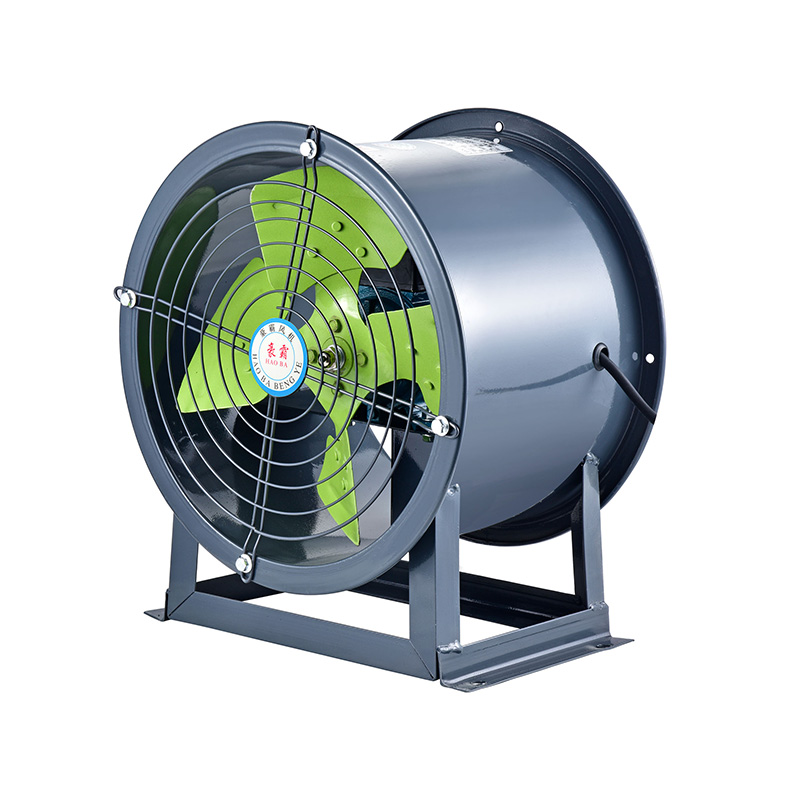
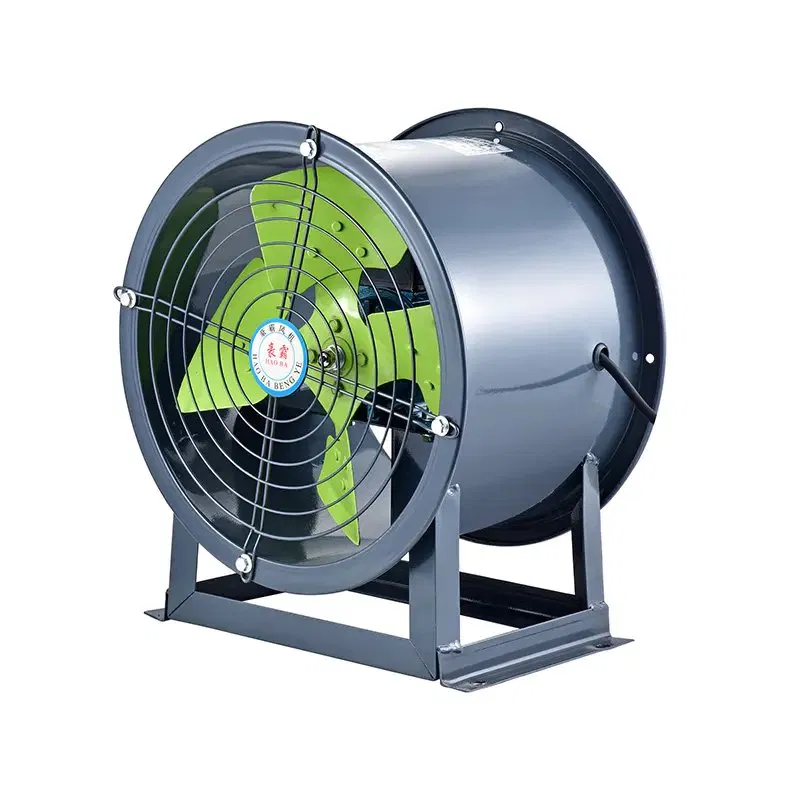
An axial fan moves air along the same axis as its rotating shaft — straight through, rather than turning the flow sideways the way a centrifugal fan does. That configuration makes it well-suited to shifting large volumes of air without needing a lot of pressure to do it, which is why axial fans show up constantly in factory ventilation, HVAC ducting, and equipment cooling setups.
The Axial Flow Fan working principle depends on three interacting variables: the pitch angle of the blades, the speed at which they rotate, and the geometry of the flow path around them. Push any one of those variables out of balance — too steep an angle, too high a speed, a poorly shaped inlet — and airflow starts to break down into turbulence. That turbulence is noise. Keep those variables in balance, and the air moves cleanly and quietly. The engineering challenge is finding where that balance sits for a given application.
Where Does Fan Noise Actually Come From?
Breaking Down the Sources
Fan noise rarely has a single origin. There are usually several things happening at once, and they interact in ways that can make diagnosis tricky.
Aerodynamic noise takes up the largest share. It comes from turbulent airflow, from vortices that form along blade edges and then shed into the downstream flow, and from the pressure waves that ripple outward each time a blade passes through a pocket of disturbed air. This category is persistent and tends to be broad in frequency range, which makes it particularly intrusive.
Mechanical noise is more familiar territory — vibration from rotating components, noise from bearings under load, the kind of irregular sound that appears when a rotor is slightly out of balance. It's more targeted in character, often showing up as a tone or a pattern rather than a general hum.
Then there is the noise that comes from how a fan is installed. Sharp bends in ductwork close to the inlet, objects blocking airflow, mounting arrangements that let vibration travel into surrounding panels — these can take a fan that would otherwise run quietly and make it noticeably louder. Installation effects get underestimated surprisingly often.
How Low Noise Design Addresses Each Source
Aerodynamic Optimization: The Blade Is Where It Starts
Blade geometry does more acoustic work than any other single design element. An aerofoil-section blade with a carefully chosen pitch angle keeps airflow attached across the blade surface rather than letting it separate into turbulent eddies. When flow stays attached, the vortex shedding from the trailing edge is reduced. Less shedding means less noise — and the effect is not subtle.
Tip clearance is another variable that gets attention in low-noise blade design. The gap between the blade tip and the fan casing is a zone where turbulence tends to concentrate. Tightening that clearance, or shaping the casing geometry around it, can bring meaningful reductions in the high-frequency noise that often characterizes axial fan operation at the blade tips.
Speed Reduction: Slower Is Quieter
There is a straightforward physical relationship between how fast the blade tips move and how much aerodynamic noise results. The faster the tip speed, the more aggressive the interaction between the blade and the surrounding air. Reduce the speed, and noise drops — not in a neat linear way, but more steeply, so even a modest reduction in rotational speed produces a noticeable acoustic benefit.
Low-noise fan designs often exploit this by using a larger rotor diameter running at a lower speed. The airflow volume stays the same. The noise does not.
Guide Vanes and Diffusers: Stabilizing the Airstream
Air leaving the rotor carries rotational momentum — it comes out of the blade plane with a spin to it that creates swirl downstream. That swirl is a source of pressure variation and turbulent noise further along the duct. Guide vanes positioned behind the rotor recover that rotational energy, redirect it into useful static pressure, and straighten the flow before it continues downstream.
Diffusers work in a related way, bringing the airflow velocity down gradually rather than abruptly. Abrupt velocity changes generate sound. A smooth, gradual deceleration keeps things quiet.
Vibration Control: The Mechanical Side
Good aerodynamic design can still be undone by mechanical imbalance. A rotor that is not dynamically balanced will vibrate at a frequency tied to its rotation speed, and that vibration will travel — through the housing, into the ductwork, and from there into whatever structure the ductwork is attached to, where it re-radiates as noise.
Anti-vibration mounts at the connection points between fan and structure interrupt that transmission path. Bearings chosen and maintained appropriately for their load conditions keep mechanical noise from developing over time. None of this is complicated, but it requires attention.
A Comparison: Standard Fan vs. Low Noise Configuration
| Feature |
Standard Axial Fan |
Low Noise Configuration |
| Blade profile |
Simple flat or basic aerofoil |
Refined aerofoil with optimized pitch |
| Rotational speed |
Higher, smaller diameter |
Lower, larger diameter |
| Guide vanes |
Often absent |
Included to reduce downstream swirl |
| Rotor balance |
Standard static balance |
Dynamic balance for smoother rotation |
| Vibration isolation |
Basic or none |
Anti-vibration mounts standard |
| Inlet design |
Standard bell mouth |
Smooth, contoured inlet to reduce turbulence |
| Application suitability |
General ventilation |
Noise-sensitive industrial environments |
None of the differences above require exotic materials or unusual manufacturing processes. They are design choices — decisions made at the specification stage that determine whether a fan installation becomes a noise problem or stays invisible acoustically. That is the more interesting point: low-noise performance is engineered in, not added on.
Wall Mounted Axial Flow Fan: A Practical Format for Factories
Not every ventilation setup involves a dense network of ducts. In many factories and warehouses, the practical arrangement is a fan mounted directly in a wall, drawing fresh air in from outside or exhausting stale air out through the building envelope. A Wall Mounted Axial Flow Fan fits that role without requiring the infrastructure of a fully ducted system.
From a noise standpoint, shorter air travel paths tend to mean less opportunity for turbulence to build. Fewer duct sections, fewer transitions, fewer bends — each of those is a potential noise source that simply does not exist in a wall-mounted setup. There is also the access factor. Wall-mounted fans are generally easier to inspect and service than units buried in ductwork, which matters because bearing condition and blade cleanliness both affect how quietly a fan runs over its operating life.
Bifurcated Axial Flow Fan: Handling Heat and Fumes Without Compromise
Some industrial environments are hard on motors. Spray finishing areas, chemical processing lines, high-temperature exhaust systems — the air moving through these spaces may carry heat, moisture, or chemical vapors that would shorten motor life significantly if the motor sat in the airstream. Standard fan configurations are simply not suitable here.
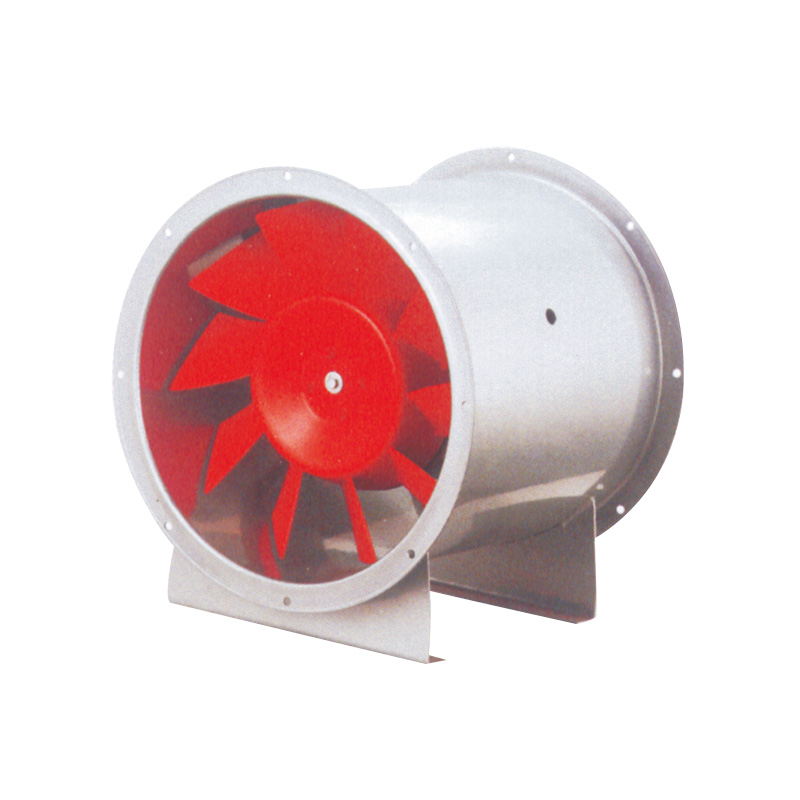
A Bifurcated Axial Flow Fan handles this by separating the motor from the airflow path. The motor and its cooling air occupy a separate chamber, while process air moves through the central passage without ever coming into contact with the electrical components. The airflow efficiency of axial design is preserved, and the motor is protected.
There is an acoustic side effect worth noting. Because the motor is physically removed from the airstream, the mechanical noise it generates has a harder time coupling into the flowing air and traveling downstream. It is not a silence guarantee, but it is a meaningful structural advantage in environments where both contamination and noise are concerns.
System-Level Thinking: The Fan Is Only Part of the Answer
A well-designed fan installed into a poorly arranged system will underperform acoustically. The installation context matters as much as the fan specification, and certain conditions consistently drive up noise regardless of how the fan itself is built:
- Blocked inlets — anything sitting close to the intake forces air to change direction and accelerate before it reaches the blades, generating turbulence that would not otherwise exist
- Tight duct transitions — sharp bends or sudden changes in duct cross-section near the fan create flow disturbances that add to the acoustic load
- High system resistance — when ductwork forces the fan to work against significant back-pressure, it labors harder and makes more noise doing it
- Resonant panels — thin sheet metal, loosely fastened access doors, and unsupported duct spans can pick up fan frequencies and amplify them into surrounding spaces
Addressing the system alongside the fan hardware often delivers results that neither step could produce independently.
Is Noise Compliance a Growing Concern for Industrial Facilities?
Many production facilities now operate within frameworks that set defined limits on workplace noise exposure and on the noise footprint the facility creates in the surrounding community. These limits have not softened over time, and the scrutiny applied to them — by regulators, by workers, and increasingly by facility management — has grown.
Choosing equipment from a reliable Axial Flow Fan Factory that treats acoustic performance as a genuine design parameter is increasingly part of how procurement teams respond to this environment. Facilities that address ventilation noise proactively tend to sidestep the more disruptive corrective work that becomes necessary when complaints or compliance reviews force the issue.
Matching the Right Fan to the Right Application
Fan selection is not a single-variable decision. The configuration that works well in one application may be entirely wrong for another, and getting the match right requires looking at the full picture:
- Required airflow volume — how much air needs to move, and at what rate, to meet ventilation targets
- Available static pressure — shaped by duct length, the number of bends, filter resistance, and any other system elements that restrict flow
- Ambient conditions — temperature and humidity ranges, and whether the airstream carries anything corrosive or flammable
- Physical constraints — the space available for the fan and whether wall mounting, duct integration, or another format is practical
- Noise targets — what sound level is acceptable at a given distance from the fan, and whether that target comes from regulatory requirements or operational preferences
Working through these factors methodically makes the eventual configuration decision much more defensible — and much more likely to deliver what the installation actually needs.
Working With a Manufacturer That Understands Both Performance and Acoustics
Picking a fan from a spec sheet gets you partway there. The harder part is knowing whether that specification will translate into good acoustic performance in the actual installation, and whether the design behind it has genuinely been engineered for quiet operation or just described that way. Taizhou Haoba Electromechanical Co., Ltd. designs its axial ventilation product range with noise reduction treated as a built-in engineering requirement rather than an optional feature. Whether the project calls for a wall-mounted unit serving a workshop, a bifurcated fan for a high-temperature exhaust application, or a low-noise configuration integrated into an occupied facility's HVAC system, the engineering foundation addresses airflow efficiency and acoustic output together. For engineers and procurement teams working through a specification, direct engagement with a manufacturer that has that depth of product and design experience tends to produce a better outcome than selecting on price or catalog description alone — and in a compliance-conscious operating environment, that difference becomes increasingly hard to ignore.


 English
 русский
 عربى
عربى
 Inquiry